
Living Like A Local on the Greek Island of Crete

7/8/2021 by David Hunter Bishop
It was a warm, mid-fall afternoon when I landed on Crete, the largest of 227 Greek islands, jutting above the Mediterranean Sea about 99 miles south of mainland Greece.
I was groggy. Five flights in 36 hours from Singapore had fogged my senses.
But I was slowly coming alive again, knowing I’d finally arrived in the birthplace of Zeus.
I’d agreed to housesit, something I’d never done before. I was apprehensive but the owners were waiting as promised to take me to their villa in rural Vrisses, a 45-minute ride to the twisting, narrow mountain roads in the rural foothills of the White Mountains.
The villa was more picturesque than even the promo photos promised, with long, pastoral views of the green countryside, a patchwork of forests, orchards, arbors and pastures rolling down toward the village. Only the plaintive bleatings of sheep and goats ambling along hilly lanes, the tinkling of the bells they wore, or the occasional neighing of a horse, could be heard.
The air was crisp, clear, clean and fresh, and the afternoon sun shone brightly in approval.
The villa itself was near perfect. Olives, grapes, pomegranates, lemons the size of softballs, all grew abundantly around it. The kitchen was large and well-equipped; the refrigerator was stocked with bottles of homemade raki, a traditional wine of Greece.
I was eager to visit the markets in the village to explore the actual makings of the vaunted Mediterranean diet and begin cooking my meals.
But first, there were introductions.
It was harvest time for olives on Crete, and several of the neighbors were already collecting the small green fruits from trees surrounding the retreat.
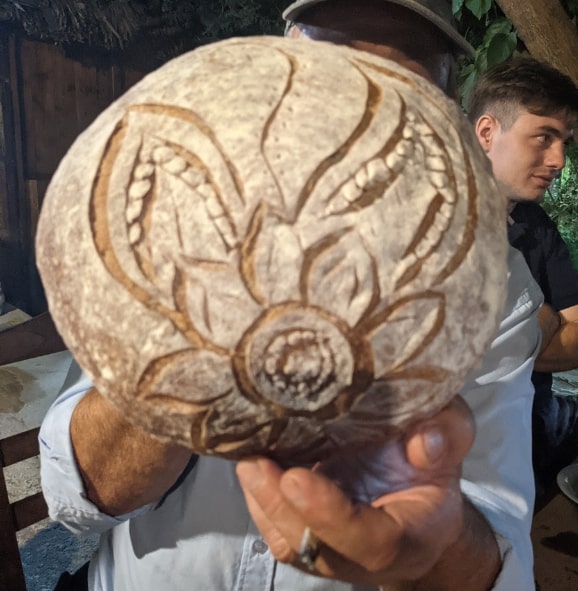
They brought fresh wild lamb with them for their meal. The young sheep are hunted for food in the mountains above the villa. They barbecued the meat in the stone fireplace adjacent to the deck and served it with fresh bread, a simple salad of fresh greens, and the ever-present raki.
The meat is not cut to exacting requirements, just chopped up with the bones and grilled on the stone fireplace near the deck. It was fantastic.
About a dozen of us sat around one table outside under the eave on the deck to enjoy the meal, the setting, new friends and a good life.
Andreas pulled a ball of foil out of his pocket, opened it and took a pinch of black pepper to sprinkle on the meat, then offered the pepper around the table. He wouldn’t eat it any other way.
Dimitrus, the villa’s closest neighbor down the road, invited us to his house the next day for more grilled lamb and wine. He promised a pilaf made with juices of the meat. Dimitrus, at 77, is also usually keen to play a game of ping pong at his house, and I was invited for a walk the next morning in the nearby mountains.
At dusk, the mountains began to block the sun's slanting rays as blue-gray skies turned toward nightfall. Gentle flames crackled in the fireplace; I was making tea, listening to Chopin, preparing for a long, comfortable night’s sleep. I had the feeling I was going to like it here.
The morning was gorgeous, crisp and cool in the valley. The sun’s rays were striving to make their first appearance above the mountains. Dimitrus, my host Christine, Tav the house dog and I joined a couple of other neighbors for the morning walk promptly at 7, a daily trek among the olive orchards, rocky pastures, coniferous trees, old, low stone walls and homes scattered along the hilly route.
When we arrived an hour later back at the villa, I prepared hot ginger tea with lemon and honey to share on the outdoor dining deck before going a few houses down the road where I’d promised to help my new friend Babis harvest olives on his property, because I crave these kinds of authentic experiences when I travel.
I enjoyed it even more because I don’t have to do it for a living. Harvesting olives is hard work, the kind of work these hardy old Greek men do regularly, the kind of work that persuaded me a long time ago in my youth that my future lay somewhere other than agriculture.
Babis handed me a mechanical harvester that looked like a weed-eater with flexible plastic rods that spun every which way at once. Stick that into the branches of the tree and the olives drop gently onto large tarps that we carefully spread beneath the trees.
Babis would carefully eye the tangled limbs for the branches with the most fruit. The sparse ones were left for a better chance to provide more fruit next season, he said.
We combed the tarps by hand to remove the sticks and leaves, then folded the tarps and carefully poured the olives into 40kg (88lb) burlap bags to be taken later to the factory press in the village, where the fruit yields its precious oil.
Babis said he makes some money for his family from the harvest, but he spat at the paltry amount he gets, then revealed the real reason for his labor.
“I am here because these are my father’s trees,” he said. “I love these trees.”
My reward for the morning was a gallon of freshly pressed oil, and the promise of more as I might need it. I’d never seen nor tasted anything quite like it, a cloudy green unfiltered mix with finely ground olive flesh floating in it, giving the oil a deep, husky aroma that made me almost want to drink it straight from the plastic jug.
So delicious, so healthful, so heavenly. Truly a gift from the gods -- and Babis.
That afternoon I walked the winding roads down to the village to explore downtown Vrisses, essentially a single through-road with small food markets, bakeries and restaurants, a service station, the all-important bus stop, an ATM that sometimes works, a couple of hardware and clothing stores, and a few other businesses on some of the side streets along with the school, municipal building, and the handsome Greek Orthodox Church.
The small center square has a modest war memorial next to an ample, tree-shaded stream that flows through the village, giving pleasure to families of ducks waddling onshore and skimming the water’s surface. You’d find tourists here, too, if it wasn’t already past the high season. This time of year, it’s a pleasantly sleepy scene.
What I’d come for was groceries, however, and I was so impressed I nearly misjudged how much I could carry back up the hill to the villa.
I’d long been interested in the vaunted Mediterranean diet and now have first-hand experience with how incredibly easy it is to follow affordably in Vrisses. I’m talking about a rich variety of healthy traditional foods, bountiful fresh fruits and vegetables, leafy greens and deep red tomatoes, yogurt, cheeses, eggs, local meats, nuts, olives and wines, all being produced in the storied Mediterranean tradition of these legendary Greek islands.
Seems everyone partakes, supplemented by the bakeries’ cookies, cakes and pastries that are fabulous but not necessarily part of the diet scheme, yet all the satisfying and nutritious components of the fabled diet these strong, healthy people eat are readily available, and their homegrown freshness makes them stunningly delicious.
After a few days my hosts soon left me to housesit alone with Tav the dog, Mythos the cat, and a large measure of welcome solitude within my beautiful surroundings. I’d already made some friends and felt at home among the neighbors and shops in the village, giving me an unparalleled sense of comfort and repose.
You might say it’s a shame that I made few excursions outside this zone, for Crete’s a large island with so much more to see and do -- hiking, exploring the culture, visiting museums and ancient ruins, amid all the spectacular scenery.
But I’d found my slice of paradise for a couple of months, content with simple walks into the village, exchanging pleasantries with the locals, running with Tav for exercise along the winding roads and into the forests, living as best I knew the lifestyle of rural Greece. I was content. Life was good.
Write A Review
Category

Most popular destinations destinations
21.09.2019 by Maya Delia
Sed ut perspiciatis unde omnis iste natus error sit voluptatem accusantium doloremque
Most popular destinations destinations
21.09.2019 by Maya Delia
Sed ut perspiciatis unde omnis iste natus error sit voluptatem accusantium doloremque
Most popular destinations destinations
21.09.2019 by Maya Delia
Sed ut perspiciatis unde omnis iste natus error sit voluptatem accusantium doloremque
Comments
But I must explain to you how all this mistaken idea of denouncing pleasure and praising pain was born and I will give you a complete account of the system, and expound the actual teachings of the great explorer of the truth, the master-builder of human happiness. No one rejects, dislikes, or avoids pleasure itself, because it is pleasure, but because those who do not know how to pursue pleasure rationally encounter consequences that are extremely painful.
21.09.2019 by Maya Delia
But I must explain to you how all this mistaken idea of denouncing pleasure and praising pain was born and I will give you a complete account of the system, and expound the actual teachings of the great explorer of the truth, the master-builder of human happiness.
But I must explain to you how all this mistaken idea of denouncing pleasure and praising pain was born and I will give you a complete account of the system, and expound the actual teachings of the great explorer of the truth, the master-builder of human happiness. No one rejects, dislikes, or avoids pleasure itself, because it is pleasure, but because those who do not know how to pursue pleasure rationally encounter consequences that are extremely painful.
21.09.2019 by Maya Delia